
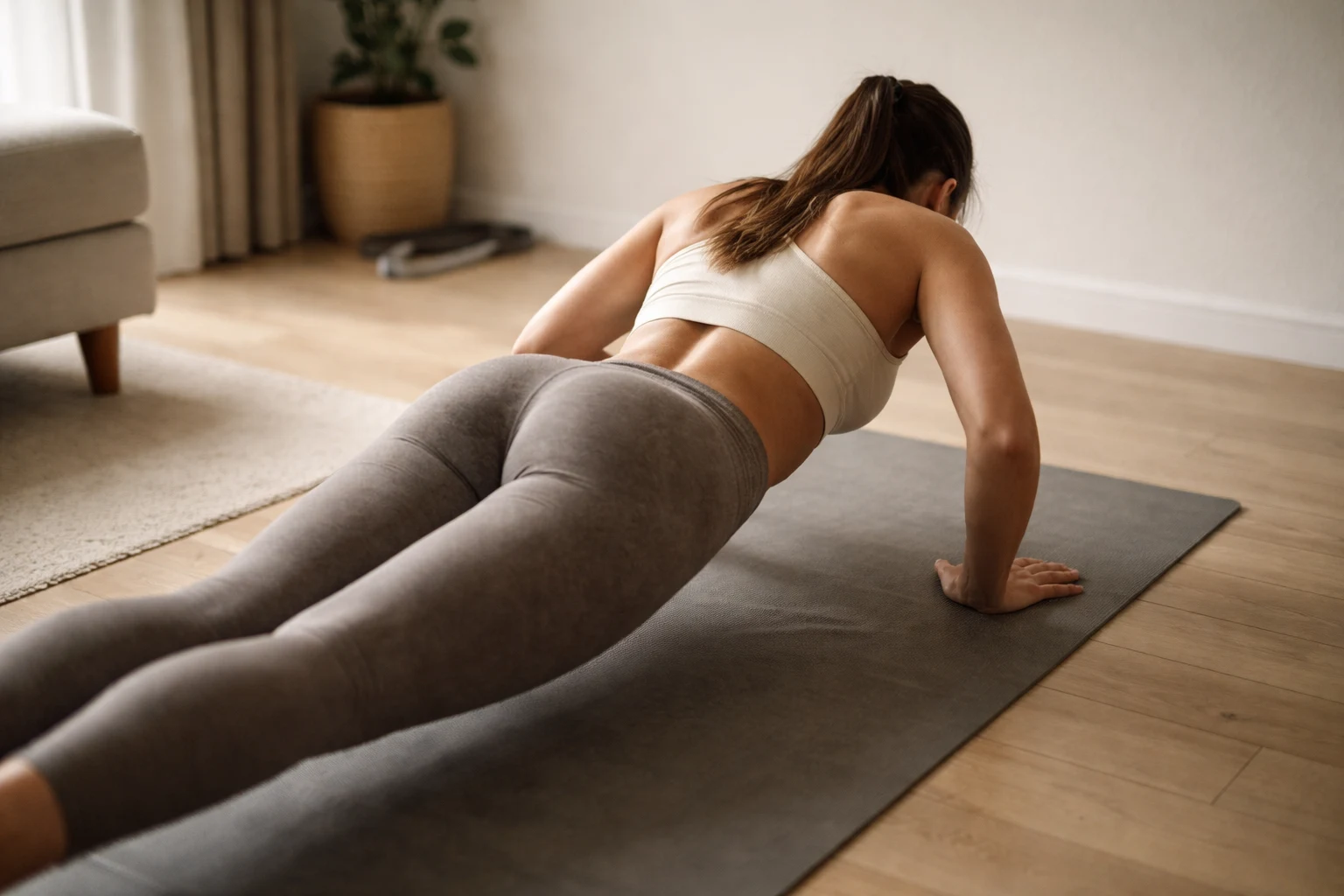
You can build real muscle with no equipment — but only if you treat bodyweight training like a real program, not a warm-up. Most home workout content is cardio in disguise: high-rep circuits, short rest, no plan for getting harder over time. It’ll get you tired. It won’t build muscle. The science behind a good home workout for muscle building is simpler than that: muscles grow in response to mechanical tension and progressive challenge — not to barbells specifically. Your muscles have no sensors to detect whether a barbell or your own bodyweight created the tension. What they detect is whether the tension was sufficient and close enough to your limit.
This guide gives you two complete programs (a 3-day full-body and a 4-day upper/lower split) and a real progressive overload system for small spaces, plus an honest look at where bodyweight training has limits — and what to do when you hit them. This guide focuses on muscle building; for a broader look at training in tight spaces, see the small-space workouts guide.
Some links in this article are affiliate links, including Amazon links. As an Amazon Associate, I earn from qualifying purchases at no extra cost to you. Learn more.
Table of Contents
- Does Bodyweight Actually Build Muscle?
- The 4 Rules of Muscle Building at Home
- 3-Day Full-Body Home Workout for Muscle Building
- Home Workout Upper Body: Push, Pull, and Press
- Home Lower Body Workout: Quads, Glutes, and Hamstrings
- How to Keep Getting Stronger Without Adding Weight
- Bodyweight Progression Selector
- The Pull Problem: Honest Talk About Back Development
- Frequently Asked Questions
- What to Do When Bodyweight Isn’t Enough
Does Bodyweight Actually Build Muscle?
Yes — with one condition: you have to train close to failure. This isn’t a fine print detail, it’s the whole mechanism.
Research consistently shows that muscle hypertrophy is largely load-independent when sets are taken to or near muscular failure. Whether you’re doing 6 reps or 20 reps, if you’re genuinely pushing close to your limit, the growth stimulus is comparable. A well-designed bodyweight program takes advantage of this by using harder exercise variants, slower tempos, and pauses to keep the challenge high — even without adding weight.
What doesn’t work: doing 3×15 push-ups that feel easy and calling it a workout. That’s maintenance at best. The marker for a productive set is that the last 2–3 reps feel genuinely hard — not painful, but challenging enough that you couldn’t have done 5 more with good form.
The 4 Rules of Muscle Building at Home
Before the routines, here are the principles behind them. A good home workout for muscle building lives or dies by these four rules — skip them and you’re just doing exercise, apply them and you’re actually training.
1. Progressive overload. You have to keep making the training harder over time. With weights, that means adding plates. Without weights, it means adding reps, slowing the tempo, adding pauses, or moving to harder exercise variations. The progression section below covers this in detail — it’s the most important part of this guide.
2. Sufficient volume. Aim for at least 4 hard sets per muscle group per week, ideally 6–10 once you’re past the first few weeks. The routines below are built around this target.
3. Train close to failure. Each set should end when you have 1–2 reps left, not 5–6. If a set feels comfortable throughout, it’s not doing much for growth. This matters more with bodyweight than with weights, because the loads are lower by default — which means the effort has to compensate.
4. Recover properly. Muscle grows during rest, not during the workout. Give each muscle group at least 48 hours before training it again. Sleep is where much of the repair happens — 7–8 hours is a useful target for many adults when results matter. Three days per week is enough to build real muscle.
One more thing that moves the needle: protein. Muscle building requires adequate intake — aim for around 0.7–1g per pound of bodyweight per day. You don’t need to weigh every meal, but if you’re consistently under this, training harder won’t fully compensate.
3-Day Full-Body Home Workout for Muscle Building
Start here if you’re newer to structured training or only have three days available. Each session covers every muscle group, takes roughly 35–45 minutes, and fits a Monday / Wednesday / Friday schedule or any three non-consecutive days. Rest 60–90 seconds between sets.
If fitting those sessions around work and apartment life is the hard part, the apartment-friendly workout planning guide shows how to build a realistic week.
The tempo notation (e.g. 3-0-1) means 3 seconds lowering, 0 pause, 1 second lifting. Slowing the lowering phase is one of the most effective ways to increase stimulus without adding weight — don’t skip it.
Before each session: 5 minutes of light movement — arm circles, bodyweight squats, hip hinges at half pace. You don’t need a formal warm-up routine, just enough to raise your heart rate and move the joints you’re about to load.
| Exercise | Sets × Reps | Tempo | Rest | Notes |
|---|---|---|---|---|
| Push-up (or variant) | 3 × 8–12 | 3-0-1 | 75s | Chest to floor. Keep elbows at 45°, core tight, head neutral. If 12 reps feels easy, switch to decline or add a 2s pause at bottom |
| Inverted Row (table edge) | 3 × 8–12 | 2-1-1 | 75s | Use only a heavy, stable table that cannot tip or slide; test it before getting underneath. Pull your chest to the edge, keep your body straight, and squeeze your shoulder blades. Harder: elevate feet on a chair |
| Bodyweight Squat (or variant) | 3 × 10–15 | 3-1-1 | 75s | Add 2s pause at bottom. Keep chest up, front knee tracking over toe. Progress to Bulgarian split squat when 15 reps feels easy |
| Pike Push-up | 3 × 8–12 | 3-0-1 | 60s | Hips high, head tracks toward floor. Shoulder-dominant movement. Engage core throughout |
| Hip Hinge / Good Morning | 3 × 12–15 | 3-1-1 | 60s | Hands behind head, hinge at hips until back is parallel. Hamstring and glute focus |
| Plank Hold | 3 × 20–40s | — | 45s | Brace hard throughout. Progress by adding time or shoulder taps |
Form check: If your lower back hurts during squats, reduce depth and focus on sitting back (not down). Keep elbows at 45° during push-ups to protect shoulders.
Home Workout Upper Body: Push, Pull, and Press
The upper-body day in the 4-day split covers push, pull, and press — the three movement patterns that build a balanced upper body. You can also run it as a standalone home workout upper body session, using 4–5 exercises across those patterns.
4-day split schedule: Upper body Monday + Thursday, lower body Tuesday + Friday. Take Wednesday and the weekend off, or swap any day to fit your week — just keep at least one rest day between sessions training the same muscle groups.
The hardest part of upper body training without equipment is pulling. Push movements — push-ups, pike push-ups, dips off a chair — are straightforward. Pull movements that build your back and biceps are harder to replicate without a bar. The inverted row and door-frame row are your best options here, and they’re more effective than they look when taken close to failure.
| Exercise | Sets × Reps | Tempo | Rest | Notes |
|---|---|---|---|---|
| Push-up variant | 4 × 8–12 | 3-1-1 | 75s | Match difficulty to current level — see the progression ladder below |
| Inverted Row | 4 × 8–12 | 2-1-1 | 75s | Use only a heavy, stable table that cannot tip or slide; test it before getting underneath. Pull your chest to the edge, keep your body straight, and squeeze your shoulder blades. Elevate feet to increase difficulty |
| Pike Push-up | 3 × 8–12 | 3-0-1 | 60s | Head tracks toward floor. Shoulder-dominant. Engage core throughout. Harder: elevate feet on a chair |
| Door-frame Row | 3 × 10–15 | 2-1-1 | 60s | Use only a solid, fixed frame—not loose trim. Hold the frame, lean back, and pull your chest toward it. Adjust the lean angle for difficulty |
| Diamond Push-up | 3 × 8–12 | 3-0-1 | 60s | Hands close together, forming a diamond shape. Keep elbows in, core tight. Tricep focus |
| Plank Shoulder Tap | 3 × 10 each side | — | 45s | Keep hips as still as possible. Core and shoulder stability |
Home Lower Body Workout: Quads, Glutes, and Hamstrings
Lower body training is where bodyweight work often performs best. Legs contain large, strong muscle groups, so higher rep ranges taken close to failure can still be demanding. A good no-equipment lower-body routine hinges on single-leg work: Bulgarian split squats and single-leg hip hinges create a serious challenge when done properly.
For apartment training: skip the jumping variations entirely. Single-leg work builds more muscle than jump squats anyway, and it’s completely silent for downstairs neighbours.
| Exercise | Sets × Reps | Tempo | Rest | Notes |
|---|---|---|---|---|
| Bulgarian Split Squat | 4 × 8–12 each | 3-1-1 | 90s | Rear foot on chair or sofa edge. Torso upright, front knee tracking over toe. The best single leg-builder in this program |
| Single-Leg Hip Hinge | 3 × 10–12 each | 3-1-1 | 75s | Balance on one leg, hinge forward until back is parallel. Keep slight bend in standing knee. Hamstring and glute focus |
| Single-Leg Glute Bridge | 3 × 12–15 each | 2-2-1 | 60s | 2-second hold at top. Squeeze glutes at the top. Start with both legs, progress to single-leg when easy |
| Reverse Lunge | 3 × 10–12 each | 3-0-1 | 60s | Step back, not forward — quieter and easier on knees than forward lunge |
| Wall Sit | 3 × 30–45s | — | 45s | Knees at 90 degrees. Good quad time-under-tension finisher |
| Single-Leg Calf Raise | 3 × 15–20 each | 2-1-2 | 45s | Use step edge for full range. Heels drop below step level at the bottom |
How to Keep Getting Stronger Without Adding Weight
Most home workout guides mention progressive overload and stop there. The useful question is what it means when you don’t own a barbell.
In practice, choose from the five methods below. For many people, adding reps and slowing the lowering phase can keep an exercise productive for weeks before a harder variation is needed.
1. Add reps. The most straightforward method. If 3×12 feels manageable, push to 3×15 before moving to a harder variant. The effective rep range for muscle building is wider than most people think — anywhere from 6 to around 25 reps builds muscle, as long as you’re working close to your limit.
2. Slow the lowering phase. A 4-second lowering on a push-up creates significantly more muscle tension than a fast drop. Try it on your next set and notice how much harder a familiar exercise suddenly feels. You don’t need to change the movement — just slow down the phase where gravity is helping you.
3. Add pauses. A 2-second pause at the bottom of a squat or at the chest-to-floor position of a push-up eliminates momentum and forces the muscle to restart from a dead stop. This is one of the most underused tools in bodyweight training.
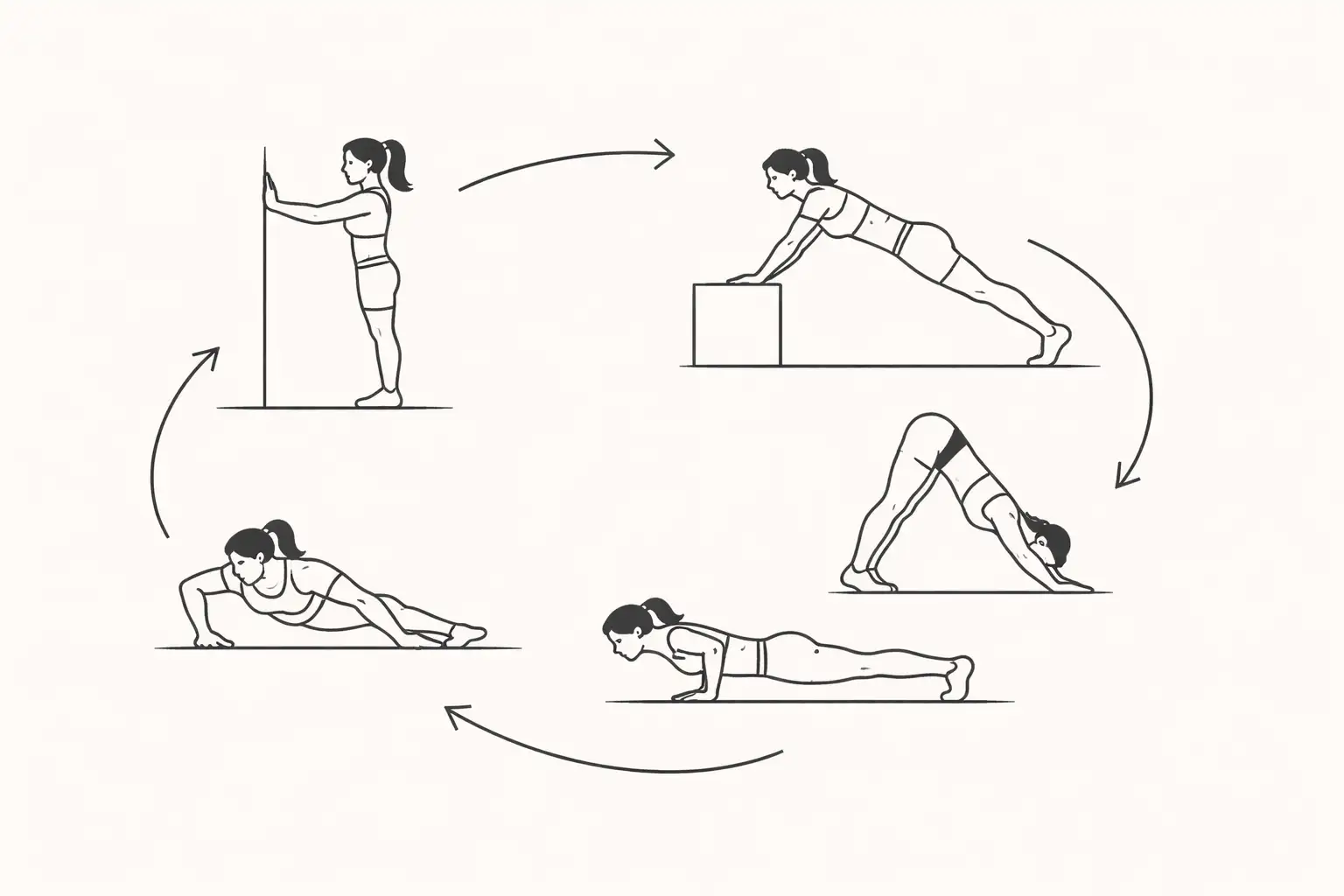
4. Move to harder variations. This is the bodyweight equivalent of adding a plate. The progression ladder below maps out the standard path. Only move up when you can hit the top of the rep range with clean form on every rep.
5. Reduce rest periods. Cutting rest by 10–15 seconds per week makes the same workout progressively harder without changing a single exercise. Use this method sparingly — prioritise the first four methods before reaching for this one.
Progression Ladder
| Stage | Push (Chest/Shoulders) | Squat (Quads/Glutes) | Row (Back/Biceps) | Move Up When… |
|---|---|---|---|---|
| Beginner | Incline push-up | Bodyweight squat | Inverted row (feet flat) | 3×12 feels comfortable with good form |
| Early intermediate | Standard push-up | Pause squat (2s at bottom) | Inverted row (feet elevated) | 3×12 close to failure throughout |
| Intermediate | Decline push-up | Bulgarian split squat | Inverted row (body near horizontal) | 3×10 challenging but completable |
| Advanced | Archer push-up | Pistol squat progression | Consider a pull-up bar — the ceiling is close | See the pull problem section below |
Bodyweight Progression Selector
Enter the best clean-form set you can do for any movement. Your next exercise variation and working prescription update as you type.
Use a recent best set, stopping when another clean rep would be difficult.
Progression plan
Add a rep count to build your plan. You can complete one movement or all three.
Results update instantly. Move up only when you can reach the top of the range with consistent form across all sets.
The Pull Problem: Honest Talk About Back Development
Back muscles — lats, rhomboids, rear delts — are harder to train without a bar. Inverted rows and door-frame rows are genuinely good exercises, but they have a real ceiling. Once you're pulling your full bodyweight horizontally with feet elevated, you've largely maxed out the stimulus available without equipment. This is the most significant limitation of pure bodyweight training, and it's worth being direct about it.
In practice, upper-back development tends to stall earlier than chest, shoulders, or legs. Inverted rows can carry you for months, but once hard horizontal rows stop progressing, the missing movement is vertical pulling. That is when a doorframe pull-up bar becomes useful — not before.
Past the row ceiling: Iron Age Doorframe Bar adds vertical pulling without drilling.
It hooks onto compatible doorframes in seconds, is rated for up to 400 lb, and uses a force-distribution design intended to spread pressure across the frame. Check your doorway dimensions and trim before buying.
Frequently Asked Questions
What to Do When Bodyweight Isn't Enough
Bodyweight training can take you a long way — often several months or more before you reach a genuine ceiling, depending on your starting point. When that happens, the next step isn't necessarily a gym membership.
Mini loop bands are most useful when squats, glute bridges, warm-ups, and accessory work start feeling too easy. They add resistance without taking up more floor space, but they are not a full substitute for the longer bands used for rows and presses.
A low-cost first add-on: Fit Simplify Loop Bands — five mini-loop resistance levels in one compact set.
The 12-inch bands run from extra light to extra heavy and work best for glute training, squat variations, warm-ups, and accessory exercises. They fit in a drawer; use the guide below if you need longer bands for full-body pulling and pressing.
Not sure whether mini loops or longer bands fit your training? Our resistance band workout guide compares the options for small-space workouts.
Conclusion
Most people who've failed at home workouts before didn't fail because bodyweight training doesn't work — they failed because they ran circuits with no progression plan. The programs above are different: specific sets, specific tempos, a clear ladder for getting harder, and honest boundaries for where equipment eventually helps.
Start with the 3-day full-body program and give it 8 weeks of consistent effort. You'll have a much clearer picture of where you are and what you need next. When you're ready to broaden the goal beyond muscle-focused bodyweight work, the beginner home strength-training guide maps the next stage.
This guide is for general fitness information only. Individual results vary based on consistency, nutrition, sleep, and starting point. If you have existing injuries, joint issues, or any medical condition, consult a qualified health professional before beginning a new exercise program.